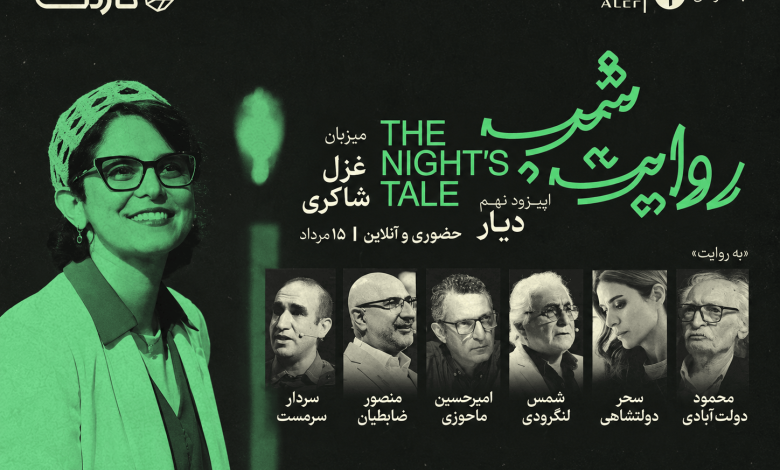
Garnet’s 9th Revayat Shab with Alef: Diyar, the Place That Stays with Us

Where is Diyar?
Is it the place where we were born? A home we once lived in? A city we left years ago? Or perhaps it is a collection of people, sounds and memories that we continue to carry with us wherever we go.
The answer may be different for each of us. Sometimes, Diyar is a point on a map. At other times, it is something much closer: a familiar street, the voice of someone we loved, the scent of an old home, a familiar poem, or an image that comes alive years later at the mention of a city’s name.
Garnet’s 9th Revayat Shab, supported by Alef, was dedicated to the idea of “Diyar” an evening for listening to stories of home, leaving, staying, distance, return, and everything that places and people leave within us.
Diyar: More Than a Place on the Map
Diyar is not always where we live today.
We may spend years away from a city and still remember its streets. A house may no longer exist, while its memory remains part of us. For some, Diyar may not even be a physical place, but a collection of people and experiences that have shaped their sense of belonging.
This is why speaking about Diyar is, in many ways, speaking about a part of who we are.
It is about the things that remain within us over the years—even as we change, take different paths, or find ourselves far from somewhere we once called home.
The 9th Revayat Shab offered a moment to pause over this shared experience and ask:
What turns a place into our Diyar?
One Night, Different Stories of Diyar
Revayat Shab is not about finding one definition for a shared idea. Each edition introduces a theme, inviting every narrator to approach it through their own experience, world and perspective.
The 9th night approached Diyar from many different directions.
Ghazal Shakeri hosted the evening, joined by Mahmoud Dowlatabadi, Shams Langroudi, Amirhossein Mahouzi, Mansour Zabetian, Sardar Sarmast and Sahar Dolatshahi, each bringing a different voice and perspective to the night.
Literature, poetry, travel, cinema, research and music came together to look at one familiar word from different paths.
For one person, Diyar may be connected to literature and language. For another, it may be a journey they returned from or a city they once left behind. For someone else, it may be a personal memory, or the people who once gave meaning to the word “home.”
The stories were never meant to arrive at the same answer just as Diyar itself carries a different meaning for each person.
Home, Memory and the Sense of Belonging
Home is not always defined by four walls.
Sometimes people are home. Sometimes a language, an accent, or even a familiar voice can bring back that same feeling of belonging. Sometimes we move far away from a place and only then begin to understand how much of it we have carried with us.
Perhaps this is why Diyar can be about both staying and leaving.
Leaving a place does not necessarily mean leaving everything behind. Memories, experiences and the things that helped shape who we are continue to travel with us.
And returning does not always mean returning to the same place we once left. We have changed, and our Diyar may have changed too.
That distance between memory and reality, leaving and returning, may be one of the most human dimensions of Diyar.
Why Do Stories of Diyar Matter?
Every person begins somewhere.
There are places, people and experiences that shape our first understanding of the world. Later, our paths may change. We may travel, build a new home, or even redefine what belonging means to us. Yet some part of that beginning stays with us.
Listening to someone else speak about their Diyar can also invite us to revisit our own.
The city we came from.
A home that may or may not still exist.
People who belong to our past.
And the things that have remained within us despite everything that has changed.
Perhaps this is where the value of storytelling lies: one person’s experience can open a door through which we begin to see our own story differently.
Alef Alongside Revayat Shab: Diyar
For Alef, standing alongside the Revayat Shab series is not simply about supporting a cultural event. It is about supporting a space where people are given the opportunity to tell their stories and where others are given the time to listen.
A supporter does not always need to stand at the center of the stage.
Sometimes, companionship means helping create the stage itself: a place where literature, music, art and human experience can come together; where there is room to listen, exchange perspectives and pause for a moment within the pace of everyday life.
Revayat Shab 9: Diyar was also held with Alef’s support, continuing the shared journey between Alef and Garnet across the Revayat Shab series.
A journey that begins each time with a different idea, but ultimately returns to people and their experiences.
Perhaps Diyar Is What Remains with Us
People move from one place to another. Homes change. Cities take on new forms, and sometimes a great distance grows between us and somewhere we once belonged.
But leaving does not bring everything to an end.
Something from a place can remain within us: a way of speaking, a memory, an image, a poem, or even a feeling that is difficult to put into words.
Perhaps Diyar is not only the place where we remained, but what has remained with us from that place.
The 9th Revayat Shab created space to hear these traces of belonging the stories of people who each found their own path back to the idea of Diyar.
And perhaps, after the night came to an end, one question remained for each of us:
If we set aside all the places we have lived, which people, voices and memories would still carry the meaning of “Diyar” for us?


One Comment